Dad to Sons, Iron Sharpens Iron

I recently came across a book that is very meaningful to me for a couple of reasons. First, Jerry Bundren has been a friend for many years.  We went to high school together and he actually tutored me in my math classes. I was Best Man in his wedding. Jerry went to college and then into the Navy. Thankfully, we’ve been able to stay connected.  Secondly, family is very important to both of us. We each have 2 sons and doing anything we can to help them develop into godly young men takes high priority in our lives.

Jerry wanted to impart some wisdom to his sons, to share some life lessons, biblical principles and spiritual truths he had gleaned to help them in life. He began to write letters and as he did, he realized those letters weren’t just for his sons but for himself as well. God began to speak to Jerry and to show him truths in the Scripture that he hadn’t seen before.

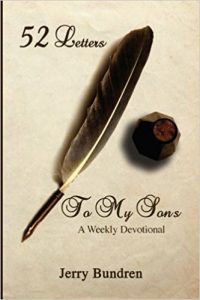
He then realized that not only could he and his sons benefit from the letters but others could as well. 52 Letters To My Sons, A Weekly Devotional, is the result. Here is an excerpt from the Introduction:

I’ve enjoyed every season of our lives together, the good and the not so good – and it just keeps getting better! Of all the jobs I’ve ever had, I have to say that my job as husband and dad is the one I love the most. And although I know if I do my ‘dad’ job correctly I’ll work myself out of a job, that truth makes my resolve even stronger to be the best dad I can be.

In fact, as our sons are growing older, I’ve found that I’ve already started working on my “exit strategy.” I’ve started transitioning my role from that of ol’ dad – the disciplinarian, the “Ogre,” the “Killjoy” – to one of counselor and mentor, and, hopefully, eventually, if all goes right, friend. It is for this reason that I decided to write the following letters to my sons, to provide them with some of the insights and wisdom that others, along with the Word of God, have provided me over the years.


This book has been very encouraging to me. I hope you will take the time to grab a copy, sit down with a cup of coffee and enjoy!

Here is a link to purchase: https://www.amazon.com/s/ref=nb_sb_ss_c_2_11?url=search-alias%3Dstripbooks&field-keywords=52+letters+to+my+sons&sprefix=52+letters+%2Caps%2C148&crid=NSGBQZRJFJP2&rh=n%3A283155%2Ck%3A52+letters+to+my+sons

Camping As A Way Of Life

We grew up camping. I remember summer evenings, holidays, church retreats, and youth group gatherings on my family’s property out in East Texas. We would shoot fireworks on the 4th of July, play paintball with the youth group, cook over the open stove and play hide and seek in the graveyard. We would have family reunions under a giant oak tree, being sure to avoid the open-air well that may or may not still be functioning. That property is where I learned to drive a car, where I first drove a stick shift, and where I learned to drive a motorcycle. Our dog is buried there. So many important memories in my life stem from my connection to that piece of land.

But it’s not just my life. I’ve heard stories of cousins, uncles, aunts, my parents, my grandparents, and their families and extended families with incredible memories of a farm in Enloe, Texas. While some of my family members actually have lived, and still do, in Enloe, I’ve learned over the years how important it is to still be connected to land somewhere. While I don’t personally own land, I cannot forget the feeling of what it’s like to sleep under the stars, to eat over a fire, and to sit around late at night, hearing crickets and frogs, telling stories as the crisp night air sets. You can’t forget roasting marshmallows, coffee in a percolator, and the wet mist of the grass.

To me, this lifestyle is vital to my health. I’m a city-dweller. A suburbanite. It’s hard for me to understand what it’s like to grow food, to till the land, and to be subject to nature. We spend much of our lives actively trying not to connect to the land—we buy from grocery stores and probably haven’t seen what many produce items actually look like in the ground, we cook with an electric burner, we have air-conditioning that keeps us from smelling and feeling the wind’s breeze.

It’s interesting—every time I “go camping,” I feel revitalized. While I’ll probably never live on a farm, I hope I can at least stay connected to the earth.

AJ

More than Just a Financial Plan – Living like a minimalist

This could be described as way of life or life style that can impact most facets of our lives including our financial plan. My bend is financial services and life insurance planning, so I think in terms of budgets, saving and investing as it relates to frugal living. Minimalism is a life style choice that encourages the elimination of excess in one’s life.

This article is more than a financial thought process as it speaks to “being more with less”. Then, “living  with  intention” and finally, “achieving freedom from consumption”.  I can see where several of  these bend toward saving money. That’s a good thing!

Check out the full article but here is a snippet:

Write down your goals: You have to start somewhere.  Do you have a financial plan?

De-clutter all of your belongings: Always a great feeling when completed.

Donate duplicates: Yes, purge and help someone else.

Own versatile clothing:  It simplifies life.

Become more Eco –Friendly:  Personally, I need reminders and need to get better.

Repeat meals: Mine is oatmeal and dry wheat toast with honey. For variety, add blueberries and pecans in the oatmeal!

Eliminate toxic relationships: Liberating, freedom and peace come to mind.

Pack and travel lightly: If you can get it going, it makes life so much easier.

Remember that experiences are greater than things: There’s always room for improvement here. So True!

Don’t be too hard on yourself: Let it go. Reminds me of “Let Go and Let God”.

For the full article, click here:

https://www.msn.com/en-us/lifestyle/smart-living/10-ways-to-start-living-like-a-minimalist/ss-BBzQKsc#image=1

Benefits of Universal Life Insurance

Universal Life was originally designed for flexibility and to compete with the “Buy Term and Invest the Difference” concept.  Southwestern Life in Dallas, Texas, had fancy marketing pieces that illustrated how a policyholder could utilize the flexible design of these plans. Nice graphs would show how a young family man or woman could buy a large policy in their 20’s and could raise or lower the death benefit as needs changed, raise and lower the premiums as the budget may dictate, as well as extract cash for times of need.

The early Universal Life plans ideally could be the one policy that could effectively meet the needs of the consumer from beginning to end. Now Universal Life, particularly Indexed Universal Life, policies are geared toward cash value accumulation. One component that the new policies have that older Universal Life policies did not have are the secondary guarantees.

 Personally, I like the Guaranteed UL plans regardless of your objective. If you are wanting to build cash values, many of the Indexed Universal Life plans have Guaranteed No-Lapse provisions built into the plans.

If you are simply wanting to have a Guaranteed Permanent Life Insurance policy at the lowest cost possible, an ordinary Guaranteed Universal Life plan is the best life insurance plan for you. The Guaranteed UL plans provide a Guaranteed Premium and Guaranteed Death Benefit to Age 100 and beyond.

Talk with an Agent or Advisor about how Universal Life Insurance can meet the life insurance needs for your family.


Stay and Play: Balancing Life, Work, and Family

Stay and Play: Balancing Life, Work, and Family

I am employed at a university with a fairly structured work schedule: a 9-5 job. My wife is a full-time graduate student, which amounts to basically a full-time job with zero pay. I also have a 20-month-old daughter, someone I love to be around and only wish I could be around more. In Illinois, where we live, the median cost of child care per child is $12,697 for the whole year, one of the highest in the country.

In our current situation, all this means that my annual income of $43,000—or $24,000 after taxes, health insurance, social security, retirement, etc.—must support rent, food, transportation, and, of course, child care. We live in the wealthiest county in the state, and so our extremely simple apartment costs $1000/month, leaving us with $12,000 to spend on food, transportation, and, of course, child care each year, or another $1000/month. Gratefully, our childcare costs are only $8000 a year. My gross income is too high to qualify for federal assistance, and so, what does any father do when trying to provide for his family? Get a second job.

I have a Master’s degree in teaching and so recently picked up teaching classes in the evenings at local community college. Monday, Tuesday, Wednesday, and Thursday from 7:00-9:50pm, I drive ten minutes to College of DuPage, the largest community college in the United States, and teach. Two semesters of teaching will give us enough to pay for childcare.

But, this all came to a head last week when my 20-month-old ran to our front door at 6:40 as I was leaving for class, and screamed, “Stay! Play!” It was an entirely harmless request—a very genuine appeal from a daughter to her dad. But, it was also harmful…to me, at least. Working 9am-9:50pm means that I don’t see my family, don’t get to spend time with my daughter, and hardly eat. All so that my wife and daughter go to school. I realize that this is only a short season in life where we’re in this situation, I know there are other solutions out there, and I know other families have it much worse than we do, but seeing your daughter—who only has a 100 word vocabulary—muster up the two words whose combination could move mountains was devastating to me.

My hope is that one day I will be able to find a balance between life, work, and family—the last of which ought to take primacy.

Guest Blogger AJ

Why we chose life insurance


Why we chose life insurance

I’ve always been a little skeptical about purchasing life insurance. The reasons not to were convincing to me for a long time:

  1. Why spend money that I may not ever get back when I could be using it now? This is the “hedging your bets” argument.
  2. If I were to die, shouldn’t my extended family and friends come around my immediate family to take care of them?
  3. Once my family does get the death benefit, won’t 99.9% of it go to taxes anyway?

But, despite these reasons, we decided to finally purchase life insurance for two important reasons:

  1. Family income: We realized that even though tax must be paid on interest income, the money from life insurance provides vital supplementary income for daily living, college education, and other big expenses such as purchasing a home so that family can be a bit more stable. (I did learn that life insurance proceeds are NOT subject to Federal Income Tax).
  2. As an investment: There are some policies out there—such as cash value life insurance—that allow money to grow over time, while simultaneously providing a death benefit in the event of death. There are reasons to invest in traditional accounts—IRAs, 401Ks, etc.—but we felt we had exhausted these enough that we needed another investment vehicle. In other words, we were going to invest anyway; why not allow it to also provide a death benefit?

Why are you choosing to purchase life insurance? Why not?

Guest Blogger: AJ

A Power Rangers Review by a Shameless, Raving Fan of the Original Series (with mild spoilers)

A Power Rangers Review by a Shameless, Raving Fan of the Original Series (with mild spoilers)

Overall: I really liked this movie. I was surprised, but the “dark and gritty reboot” spin didn’t mess it up for me. It was fun, funny, nostalgic, and its own thing at the same time. The whole “power of friendship” thing really worked here. In most movies, that sort of theme comes across as cheesy, but I understand now why they made the Power Rangers the “troubled teens” in this version. It gave them room to grow as they found family with each other. They took the basic structure of a Power Rangers episode and fleshed it out with meaningful characterization. Almost like they threw a little “The Breakfast Club” in there, which is never a bad thing. Power Rangers 2017 is cool movie in its own right, and if you’re a fan of the original show, it delivers in the throwback elements, too. It WAS darker and grittier, but it still FELT like Power Rangers.

For all you 90s kids out there, here’s a little breakdown of the morphinominal (and not-so-much) aspects of the movie, complete with a few unqualified, nostalgic references juuuust for you:

Liked:

1) Bryan Cranston as Zordon was AWESOME. He worked on the original show, and Billy Cranston, the Blue Ranger, was named after him. And yes, he nailed the Zordon vibe. So great!

2) Billy was on the autism spectrum, and he was easily the best character in the movie. He was legitimately funny. RJ Cycler did a pretty good job acting as this character, too. Really cool move by the filmmakers.

3) Jason grew from a character who is very different from the cool, staid, humble leader of the original series into someone who is closer to that character by the end of the film. It gave his character a lot of depth. But I still miss Austin St. John. #You’llAlwaysBeMyHero

4) Naomi Scott. Her Kimberly was very close to Amy Jo Johnson’s. The subtle details of her performance made this feel like Power Rangers more than anything else in the movie did. She anchored the show. And I just really like her as an actor. She was in Terra Nova, another one of my favorite nerdy shows–incidentally, also involving dinosaurs.

5) Alpha says “Ai-ai-ai!”

6) Rita says, “Make my monster grow!”

7) Jason says, “It’s morphin’ time.”

8) Defeating Rita a la Team-Rocket’s-blasting-off-again.

9) Kimberly cliff jumps — a throwback to the coolest scene from the original movie.

10) There are mature themes, but they are handled appropriately for a movie aimed at this age group. They don’t gloss over things, but they aren’t showing the intimate pictures, etc. It’s clear what’s being discussed, but it’s also clear the film is not about sensationalizing kids. (Except maybe that swimming scene at the beginning. They show Kimberly in her underwear, which seemed a little out of place in a movie targeting a younger demographic.)

11) Zordon and Rita were Rangers. This fills in a lot of questions from the original about how Rita acquired the Green Power Coin. And it sets up the sequel nicely.

12) That mid-credits scene . . . “Tommy Oliver,” with the legendary jacket draped over the chair.

13) Best part: Y’all. There was a cameo. They said there wouldn’t be, but there was. I’m not gonna spoil it, but . . . I almost screamed.

Didn’t Like:

1) Rita’s whole dominatrix outfit thing. Or her general, creepy vibe.

2) Zords were weird. (Why did the Mastodon have six legs?)

3) Goldar was weird.

4) Alpha was weird.

5) Zordon was a Pin Art 3D

6) The original theme played at an out-of-place time.

7) There were no beepers. Alas, the 90s, you are no longer with us. 🙁

8) Billy: “We’ll call it a . . . a MEGAZORD!” (Not the exact quote, but basically.)

9) Bryan Cranston never told the Rangers that he is the one who knocks.

Mixed Feelings On:

1) The Command Center was okay.

2) The struggles piloting the Megazord reemphasized the Power of Friendship rule and addressed a major plot hole in the original version. (How did the Rangers learn to pilot a giant mech in two seconds?) The suit interface with the Zords helped explain that, too. Still, I kind of wanted the Megazord to throw back to the TV show–lightning sword and everything. 3) Zack’s subplot–taking care of his sick mother–was wonderful. The cultural aspects of his role were very respectful and well performed. He genuinely felt like an Asian-American student with a foot in the culture of his upbringing and a foot in American youth culture. His performance also carried all the frustration and posturing that often comes with living in two worlds at once. I loved Ludi Lin’s character through and through–I just wanted more of him. 4) Trini was also a fantastic character. Unfortunately, just like in the original show, we didn’t get to zoom in on her as much. My favorite scene of hers scene was at the campfire when she gets really vulnerable. It was so well done. Becky G had the most difficult role to play, and she might have been the best actor on the show. She sold me on Trini. Again, I really wanted more of her. Conclusion: 7.5/10 Power Rangers 2017 was great. It was a fun ride, a well-paced story, and it had some solid actors that made the characters relatable and believable. I think Millennial fans of the original, teens, and kids can all find something to enjoy about it. I’m excited to see where they take the franchise from here. If you’re taking your kids to see it, be aware that there is darkness, creepiness, and mature subject matter including death, sexual attraction, sexting, and how generally messed up teenagers can be to each other. But there’s also a lot about self-forgiveness and the benefits of community that’s pretty–well, powerful. Be prepared to talk to your kids about this stuff. Or don’t take them if you think it’s not right for your family. But the reality is, this is stuff that teenagers deal with, and I think the movie presents it in a way that you can have a great conversation about it. All in all, if you’re looking for a fun, spring action flick, Power Rangers is a good one to see!

Guest Blogger: JJ
 

Tracking The Affordable Care Act?

I received a Newswire from the National Association of Health Underwriters ( NAHU ). For those that are tracking the Affordable Care Act and the impact that it has on all of us may find this blurb and article to be interesting. You may recall that it was a given that without the mandate for coverage the ACA would not work. Understanding that the repeal is on, without the IRS enforcement this would be the proverbial “taking it apart at the seams”! I just hope the Republican plan can turn the ship without sinking it.


IRS To Pull Back On Enforcing ACA’s Individual Mandate For Coverage.


The Washington Post (2/15, Goldstein) reports the Trump Administration is making its initial changes to the Affordable Care Act by “reversing plans to withhold tax refunds this year from Americans who flout an insurance requirement in the law.” Under the Obama Administration, the IRS “had announced that it would no longer process tax returns for people who fail to send a notice with their returns that they have insurance, are exempt from the requirement or are paying the fine.” But on Wednesday, the IRS revoked this rule, saying instead that “tax returns will be processed as always, even for individuals who do not provide the required information.”


Want Better Life Insurance Rates ?

Many things effect life insurance rates. One factor can be high blood pressure. Want to live longer? Want to have lower life insurance rates? Consider the Dash Diet. You’ve never heard of the DASH Diet? DASH stands for Dietary Approaches to Stop Hypertension. We know exercise, diet and medication can impact blood pressure. Controlled high blood pressure means better life insurance premiums. The DASH diet is low in fat and sodium but rich in low-fat or nonfat dairy foods, healthy fats, fruits and vegetables. It can lower blood pressure.


How can you add DASH to your lifestyle? Make small changes first by changing only your fruit and vegetable intake. You can do this! Keep track of the fruits and vegetables you eat and slowly add more to your diet. Your goal is 8 to 10 servings a day. A serving of most vegetables and fruits is only ½ cup, about the size of an ice cream scoop. If you have health issues that cause you to have too much potassium in your blood  you may need a diet that is lower in potassium than the DASH diet.


Consider these suggestions for eating more fruits and vegetables:

  • Try to eat fruits and/or vegetables at every meal. Take fruit to work or school as a snack.
  • Make a baked potato bar. Serve baked potatoes with a variety of toppings such as broccoli, chili, salsa, and beans. If you use toppings from a can or jar be sure to choose low-sodium varieties, or even better, make them yourself from fresh ingredients. Be creative. You could end up with 4 to 5 servings of vegetables at one meal.
  • Try nonfat or low-fat yogurt topped with fruit and unsalted nuts.
  • For a snack, have a smoothie made with low-fat or fat-free milk and frozen fruit chunks.
  • Combine a ready-made pizza crust with low-fat mozzarella cheese and lots of vegetable toppings. Use tomatoes, squash, spinach, broccoli, carrots, cauliflower, peppers and onions.
  • Use a variety of cut-up vegetables with a low-fat dip as an appetizer instead of high-fat chips and dips. Try some new vegetables.
  • Make a stir-fry containing lots of different vegetables and serve over brown rice.
  • Try some vegetarian meals using beans and peas.
  • Add garbanzo beans to a salad.
  • Use fat-free refried beans.
  • Make split pea or black bean soup.
  • Buy a vegetarian cookbook and try one recipe each month or each week.

Once you are eating the right amount of fruits and vegetables each week, move on to other changes. Eat less saturated fat found in meats, dairy products and processed foods. Use vegetable oils such as canola, olive, and corn oils. Eat healthy fats from nuts and fish. Eat less sodium by cutting down on how much processed food you eat such as snack items, lunch meats and canned soups. Buy frozen meals that have less than 400 milligrams of sodium listed on the label. Drink fat-free (skim) milk. A glass of fat-free milk has only 80 calories and no fat and is packed with blood pressure-lowering nutrients. Get 2 to 3 servings of milk or milk products every day. For breakfast, have whole-grain cereal, fruit and skim milk.


Try these suggestions and you will be on your way to a healthier diet.

(Dietary suggestions offered by c. miller of aetna)

EASY ON-LINE LIFE INSURANCE APPLICATIONS

The National Association of Insurance & Financial Advisors ( NAIFA ) Smart Brief reported that a major reason consumers are shying away from purchasing life insurance is due to complexity in the application process. I do understand that this society is all about point and click then on to the next flash of information or on to the next barrage of daily activities.  Having been involved in the Group Insurance/Worksite Marketing stage of life insurance selling, I know firsthand that people do love simplicity when it comes to making life insurance decisions. Younger and middle-aged consumers will often leave family life insurance needs unmet  and perhaps it is due to lack of simplicity in the application process.

Employers are shifting more and more to a self enroll model thereby eliminating face to face consultation.  Life Happens notes that 66% Americans under the age of 40 indicated that “purchasing a life insurance policy is complicated.” And 54% of the U.S. adult population feels the same way. Perhaps I am “old school” but what about just meeting with an agent? They can help explain the products and facilitate the application process.

If you insist you can do it all over the phone and internet but we have Qualified Top Agents that you can talk with about your life insurance needs.  Additionally, we have a very simple application process available. You can get a rate and even start the application process by spending less than 10 minutes. The rest of the process is handled by the pros. It is really streamlined and easy for the consumer.

Additionally, we have carriers that will underwrite life insurance applications on a non-medical basis, meaning No Medical Exams are required in order to be considered for approval. You can apply and have an approval all within 30 minutes.

If our Agents can be of help to you, please Click Here     or call us at 817-545-3900.